Equipment chapter 02 / Lenses
Decide how to frame
Choose a lens for the relationship you want between subject, surroundings and shooting position—not simply to fill a gap in a focal-length list.
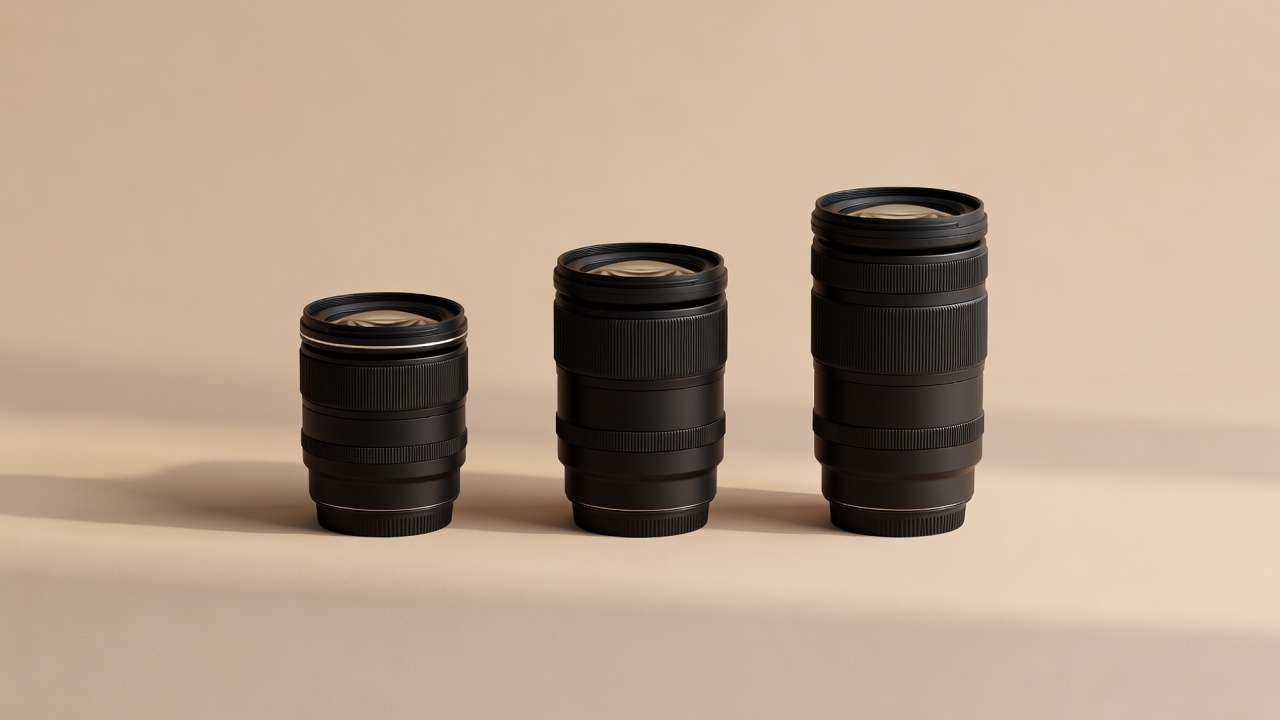
Describe the frame before the focal length
Begin with where you can stand and how much of the scene belongs in the picture. A portrait in a small room, a distant animal and an architectural detail all create different constraints. The right question is not “Which lens is more advanced?” but “Which lens gives me the field of view and working distance this photograph needs?” Your current zoom may already cover the answer.
Review photographs you like from your own archive. Note which focal lengths recur and where you consistently run out of room or reach. Then spend an outing at one focal length, changing your position deliberately. This separates a genuine equipment restriction from a habit of standing in the same place.
Connect focal length, format and viewpoint
Focal length is a physical property of the lens. The angle of view it produces also depends on the sensor format. A 50 mm lens does not change its focal length when mounted on a smaller sensor, but the recorded frame is narrower. Full-frame-equivalent descriptions help compare framing across formats; they do not turn one lens into another.
Perspective is governed by viewpoint. When you move closer for the same subject size with a wider lens, near and far features appear differently related because your position changed. From the same position, different focal lengths mainly change framing. Remembering this helps you avoid expecting a new lens to create a perspective that requires a different shooting location.
Useful for including surroundings or working in confined spaces. Watch edges, nearby foreground objects and the temptation to include too much.
A flexible starting point for daily observation and environmental portraits. The exact focal length depends on format and personal preference.
Useful for distant subjects and selective compositions. Requires attention to stability, subject tracking and the air between you and the subject.
Treat aperture as a trade-off
A wider maximum aperture can support faster shutter speeds in low light and give more control over depth of field. It may also increase lens size, weight and cost. A very shallow focus zone is not automatically desirable: a moving subject or a group portrait may need a smaller aperture to keep important details sharp.
Depth of field depends on aperture, focal length, subject distance and the conditions under which the final image is viewed. Background appearance also depends on the distance between subject and background. Before buying a faster lens for blur, try moving your subject farther from the background and choosing a cleaner viewpoint. That adjustment may be more effective than a modest aperture change.
A lens earns its place when its way of seeing helps a picture you actually make.
Choose between flexibility and restraint
A zoom lets you vary framing without exchanging lenses, especially useful when your position is restricted. It does not remove the need to choose a viewpoint. A prime offers one focal length and may provide a compact package or a wider aperture, but those advantages are model-specific. Neither category is inherently a better learning tool.
For travel, a modest zoom may prevent unnecessary lens changes and keep the bag manageable. For a consistent personal project, one prime can make decisions simpler. For close-up work, check minimum focus distance and maximum reproduction ratio rather than assuming that any long lens behaves like a macro lens. Different problems call for different specifications.
Compatibility is more than a mount name
Check the complete lens designation against the exact camera body. Mount families include Canon RF, Nikon Z, Sony E and Micro Four Thirds, but naming a family is only the start. Sensor coverage, firmware, autofocus support, aperture control and stabilization behavior can all affect use. Some smaller-format lenses mount on larger-format bodies but trigger a crop or produce incomplete coverage.
An adapter may preserve certain functions and limit others. Mechanical fit alone does not promise full autofocus performance, electronic communication or safe clearance. Avoid forcing a lens or stacking unfamiliar adapters. Consult the manufacturers’ current instructions for both the body and lens, including any third-party compatibility notes.
- Confirm mount and sensor coverage using exact model names.
- Check autofocus, aperture and stabilization support.
- Include hood, filter size, carrying space and tripod-collar needs.
- Inspect used lenses for damage, fungus, haze and inconsistent operation.
- Test at the distances and apertures you actually expect to use.
Try a small experiment before committing
Rent or borrow a candidate lens if available. Give it a clear assignment rather than collecting random test frames. Compare the number of useful photographs, the carrying burden and the ease of getting the shot. A technically impressive lens that stays home is a poor answer to a recurring practical problem.
If framing is already comfortable but results still feel flat or inconsistent, another lens may not be the next step. Continue with light direction and control, or return to the equipment decision map to name the limitation more precisely.